
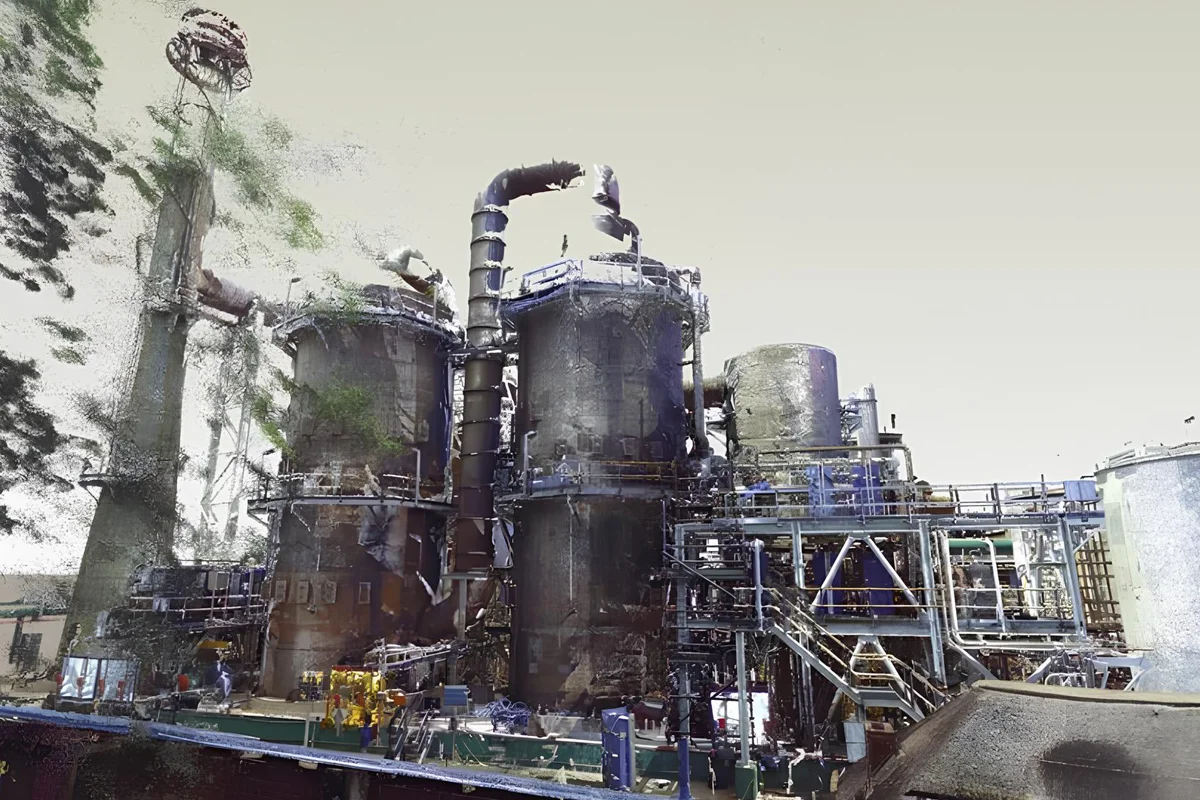
Micro Summary: How much 3D Laser Scanning accuracy is needed for pipe and steel fabrication? Sandile Shembe breaks down the tolerances that actually matter.
3D laser scanning accuracy for pipe and steel fabrication typically needs to deliver within ±2mm to be usable for off-site fabrication, since that’s roughly the tolerance most flange connections, pipe spools, and structural steel fit-ups can absorb without on-site rework. Terrestrial laser scanners used in plant environments generally capture well beyond that, often to sub-millimetre precision so the accuracy of the scan itself is rarely the limiting factor. What matters more is registration quality and how carefully the point cloud is processed before anyone designs against it.
Why “How accurate is the scanner” is the wrong question.
Every scanner spec sheet quotes an impressive number, and it’s genuinely true. Modern terrestrial scanners are more than accurate enough for fabrication work. The real risk isn’t scanner hardware. It’s what happens between capture and use:
- Registration error. Stitching multiple scan positions together incorrectly can introduce drift across a large plant, even if each individual scan is accurate.
- Modelling interpretation. Converting a point cloud into a usable model or drawing requires a modeller who understands what tolerance the fabrication actually needs, not just what the software defaults to.
- Site conditions at capture. Vibration, dust, and reflective or wet surfaces on an active plant can degrade individual scan quality if the crew doesn’t know how to work around them.
This is why the accuracy that ends up on your fabrication drawing has more to do with the process and the people running it than with the number printed on the scanner.
What this means practically for a Shutdown.
If steel or pipe spools are being fabricated off-site ahead of a shutdown, this is the exact question worth asking your scanning provider before you commit: not “how accurate is your scanner,” but “what accuracy will the final fabrication drawing carry, and how do you verify it.” 3D Laser Scanning accuracy determines whether your fabricated components fit the first time.
This ties directly into shutdown planning more broadly. I’ve written about the wider process here: 3D Scanning for Plant Shutdown Planning.
Talk to an engineer about Fabrication-Grade 3D Laser Scanning accuracy.
If you’re scoping a shutdown or retrofit where off-site fabrication is part of the plan, talk to an engineer directly. We’ll confirm the accuracy and verification process needed for your specific fabrication tolerances before scope is locked in.
Choice of related article 1
Choice of related article 2
