
Expert Reverse Engineering
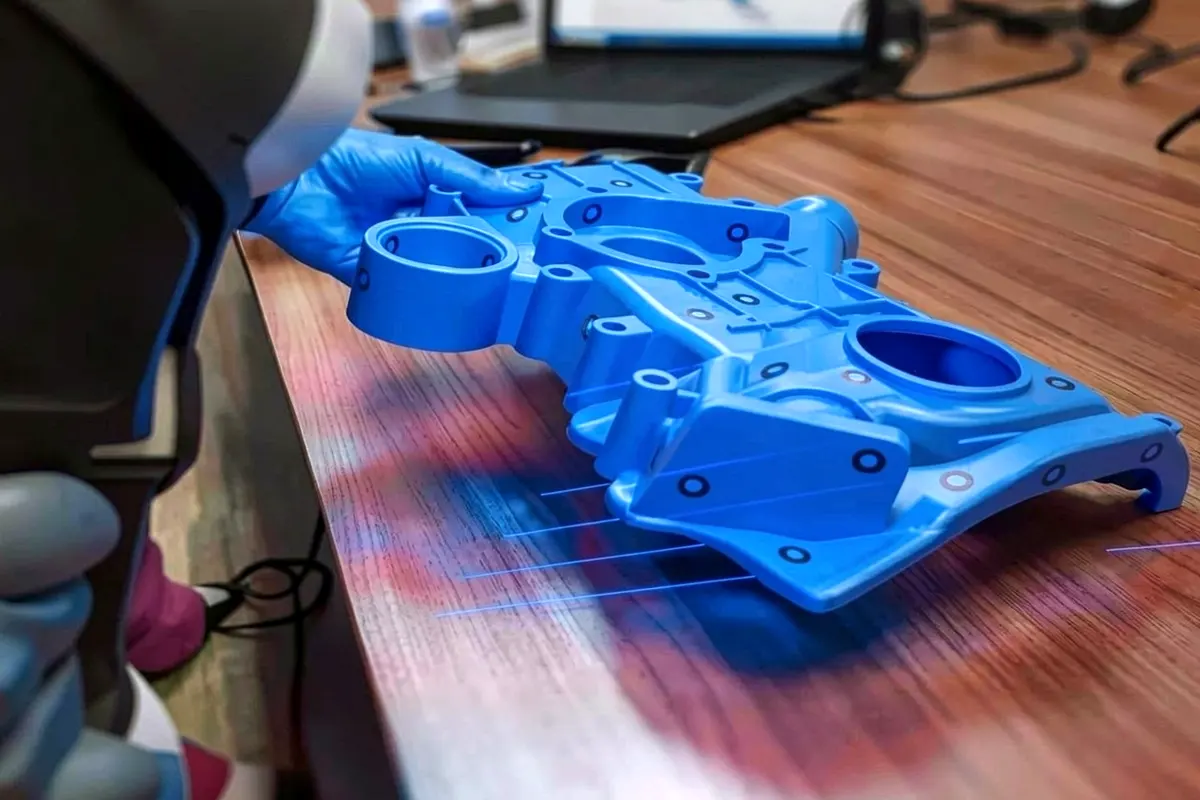
Reverse engineering starts with a 3D scan. We capture the complete geometry of your existing part or component using cutting edge 3D scanning equipment, producing scan data accurate to ±0.02mm. That scan data is then processed into a fully editable 3D CAD model in SolidWorks, Inventor, or Solid Edge – a process known as Scan to CAD (Reverse Engineering).
From that CAD model, you can reproduce the part exactly as it was, modify it to correct a design flaw, improve it with a different material or geometry, or hand it directly to a manufacturer for CNC machining, casting, or 3D printing.
For mining operations across Rustenburg’s Platinum Belt. This is where equipment runs hard, original OEM suppliers are often overseas or discontinued, and a single broken part can halt production – so reverse engineering is not a last resort but instead a standard maintenance strategy.
Replacement components are supplied with full dimensional compliance documentation, supporting MHSA maintenance record requirements for mine plant equipment in North West Province.
Operational Advantages
3D Scan the Component
We scan the physical part using professional 3D Scanning and measuring equipment. The scanner captures millions of data points across every surface, feature and internal detail accessible by the scan beam. For complex internal geometry, we combine scanning with traditional measurement techniques. The result is a complete point cloud, or data set, of the component’s existing geometry.
Process the Point Cloud
The raw point cloud data is processed in various 3D software applications to clean, register, and align the scan data. Noise is removed. Surfaces are extracted. The geometry is prepared for CAD conversion.
Scan to CAD Modelling
The processed point cloud is converted into a fully parametric 3D CAD model that can be used in SolidWorks, Inventor or Solid Edge – depending on your downstream requirements. Every dimension, radius, thread, and surface profile is modeled from the measured scan data. No estimations or approximations. This is Scan to CAD. Real measured geometry, not guesswork.
Design Review and Modification
If the original part had known failure points or design limitations, this is where we address them. We can modify wall thickness, change material grades, improve surface finishes, or redesign specific features all within the CAD model, before anything is manufactured.
Manufacturing Output
The finalised CAD model is exported in your required format – STEP, IGES, STL, DXF, or native SolidWorks files , ready for your manufacturer, CNC machinist, casting foundry, or 3D printing service. We can also produce fully dimensioned 2D manufacturing drawings to ISO standards.
Engineering Design for Rustenburg Mining
The Platinum Belt around Rustenburg is one of South Africa’s most demanding engineering environments. Processing plant structures carry heavy dynamic loads. Conveyor gantries span long distances in exposed conditions. Underground support systems must meet MHSA requirements.
We design for this environment specifically – portal frames, conveyor support structures, process plant steelwork, and infrastructure that meets both the engineering and regulatory requirements of South African mining operations.
Industrial Applications
- Platinum & Precious Metals Mining — Rustenburg
- Mining & Heavy Industry nationally
- Automotive & Transportation
- Aviation & Aerospace
- Manufacturing & Fabrication
- Marine & Offshore
- Obsolete and discontinued OEM part reproduction
- Legacy equipment component recreation
- Worn impeller, gear, and bearing housing reproduction
- Custom bracket, adapter, and housing recreation
- Conveyor and processing plant component replacement
- Pump casing and valve body reproduction
- Tooling and jig recreation for manufacturing
Technical Capabilities
Precision Scanning
Our FARO Focus and Leica BLK360 scanning equipment captures component geometry to ±2mm accuracy. For smaller, more complex parts, gears, impellers, valve internals — we supplement with high-resolution structured light scanning where submillimetre accuracy is required.
Parametric CAD Modelling
Every Scan to CAD model we produce is fully parametric, meaning every dimension is driven by a value that can be changed. If your manufacturer needs a slight size adjustment for the material they have in stock, we can update the model in minutes rather than starting from scratch.
Multi-Format Output
We deliver in whatever format your manufacturer needs. STEP and IGES for universal CAD compatibility. STL for 3D printing. DXF for CNC. Native SolidWorks files for design teams. Fully dimensioned 2D drawings for traditional machinists who work from paper. We cover all of them.
Regulatory Compliance & Accuracy
| Scanning Equipment | FARO Focus Series, Leica BLK360 |
| Scanning Accuracy | ±2mm standard; submillimetre available on request |
| Point Cloud Software | Autodesk ReCap, FARO Scene, Leica Register 360 |
| CAD Software | SolidWorks, AutoCAD, Revit |
| Output Formats | STEP, IGES, STL, DXF, SolidWorks native, 2D PDF drawings |
| Deliverable Turnaround | CAD model: 3–7 business days from scan |
| Base Location | Rustenburg, North West — national mobilisation |
3D scanning captures the physical geometry of an object as a point cloud — millions of measured data points. Reverse engineering takes that point cloud and converts it into a fully editable 3D CAD model (Scan to CAD) that can be used to reproduce, modify, or manufacture the component. 3D scanning is the measurement step. Reverse engineering is the engineering step that follows it.
Yes. In most cases. If the break is clean and the damaged geometry can be inferred from the intact portions of the part, we can model the complete component. For severely damaged parts, we may need an intact example of the same component, or we work from partial geometry and engineering judgement to reconstruct the missing features. We advise on this at the quotation stage.
Our scanning equipment captures geometry to ±2mm accuracy at standard distances. The CAD model is built from that measured data, so the dimensional accuracy of the model directly reflects the scan accuracy. For components requiring tighter tolerances, we use structured light scanning capable of submillimetre accuracy.
We deliver in STEP and IGES as standard. Both are universally accepted by CNC machinists, casting foundries, and 3D printing services. We also provide native SolidWorks files, DXF for CNC, STL for additive manufacturing, and fully dimensioned 2D PDF drawings. If your manufacturer uses a specific format, tell us at the quotation stage and we’ll confirm compatibility.
Yes. This is often the most valuable application. If the original component had a known failure point, we identify it in the CAD model and propose a design modification before it goes back to manufacture. You get the replacement part, but with the problem solved. We present the proposed change and get your approval before modifying the model.