
Why the Engineer's Stamp Matters
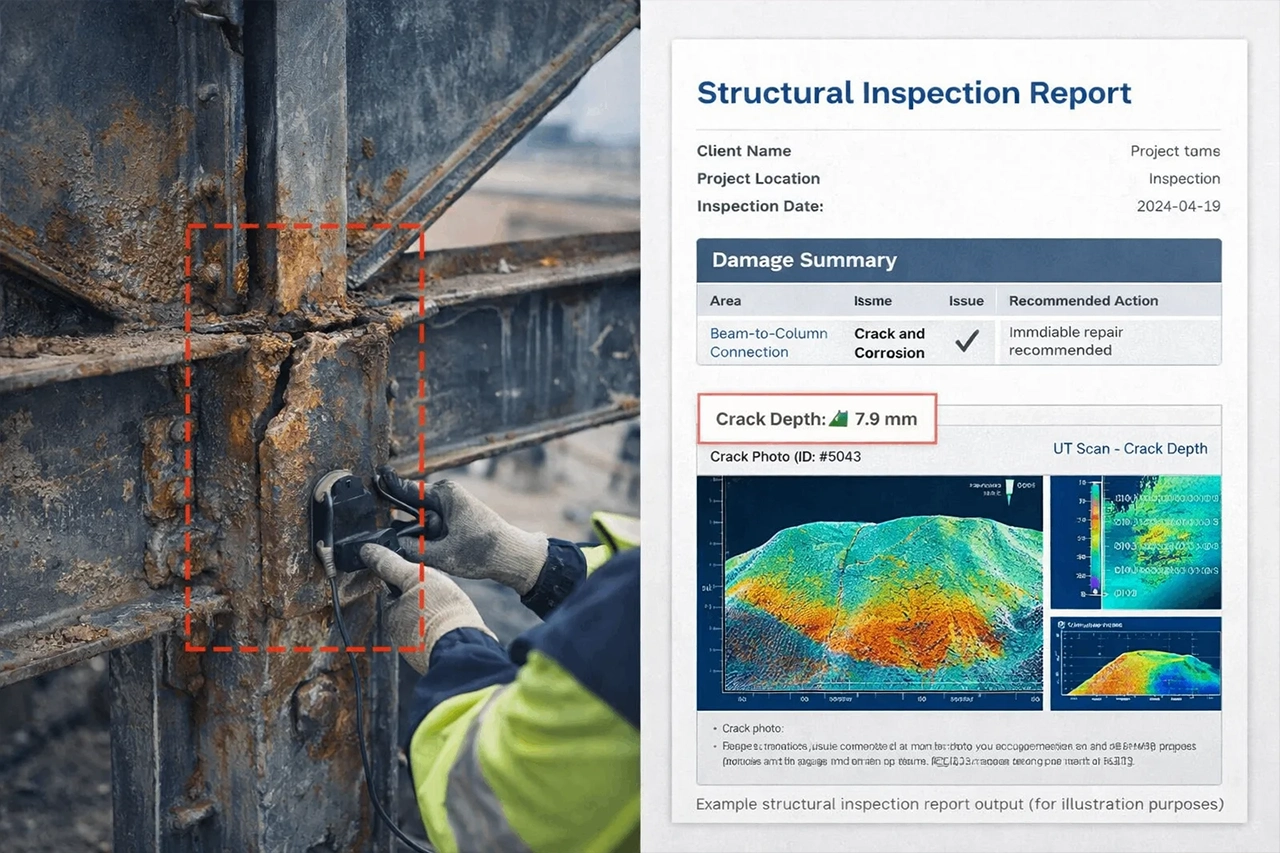
Any builder can look at a crack and give you an opinion. Only an ECSA-registered Professional Engineer can give you a signed, stamped report that stands up in a bank application, an insurance claim, a legal dispute, or a local authority submission.
Every structural inspection and building assessment is conducted and signed off by an ECSA-registered Pr.Eng – not a junior technician, not a subcontractor.
When precision matters, we combine structural inspections with 3D Laser Scanning for dimensionally accurate condition documentation, and with NDT Services where we need to check what the eye can’t see.
What you get from every inspection:
- Stamped engineering report (ECSA Pr.Eng)
- Damage assessment with photographic documentation
- Crack classification – cosmetic vs structural
- Foundation and settlement assessment where relevant
- Safety rating
- Prioritised remedial recommendations
Operational Advantages
What We Inspect
Pre-Purchase Residential Inspections
You’re about to spend millions on a property. A structural inspection tells you exactly what you’re buying – not what the estate agent tells you. We check foundations, load-bearing walls, roof structures, and signs of movement or water damage. The report is stamped and accepted by South African banks for bond applications.
Commercial & Industrial Buildings
Warehouses, factories, office blocks, retail centres. Before you sign the lease, install heavy equipment, or put people in a building, you need to know whether the structure can handle it. We assess load capacity, identify deterioration, and give you the facts.
Mining Infrastructure - Rustenburg
Processing plant structures, conveyor gantries, headgear, and shaft steelwork in platinum and chrome mining operations. We assess structural condition to MHSA requirements and give your safety department a report they can file with confidence.
Shutdown and Turnaround Structural Assessments
A planned shutdown is the only window to properly inspect elevated pipe racks, conveyor frames, and equipment plinths. Fatigue builds at connection points under combined vibration and chemical exposure – silently, until it isn’t. We work around your shutdown schedule. Scope agreed upfront, report structured for your specific requirement.
Post-Disaster Assessment
After a fire, flood, impact, or blast — the first question is whether the building is safe to enter. We mobilise quickly, assess the structural damage, classify the risk, and tell you what needs to happen before anyone goes back inside.
Crack Investigations
Not every crack is structural. Not every structural crack is urgent. We assess crack width, pattern, location, and behavior. We also identify the cause and classify the severity. No guesswork, no unnecessary panic, no missed problems.
Industrial Applications
- Platinum Mining & Processing Plants
- Commercial Real Estate
- Public Infrastructure
- Residential Developments
- Pre-purchase building due diligence
Post-disaster structural integrity evaluation
Bridge and tunnel safety inspections
Concrete spalling and corrosion assessment
Foundation settlement and crack monitori
Technical Capabilities
Registered Professionals
All inspections are overseen by ECSA Registered Professional Engineers, ensuring unbiased and authoritative assessments of your property’s structural health.
Detailed Reporting
Comprehensive engineering reports that clearly document findings, reference applicable SANS codes, and offer prioritised recommendations for repair. Accepted by banks, NHBRC, municipalities, and insurance providers.
Safety First
Our primary focus is the safety and stability of your structure. We use non-invasive techniques including GPR, cover meters, and drone inspection wherever possible to minimise disruption while maximising insight.
Regulatory Compliance & Accuracy
| Standards | SANS 10400, SANS 10160, OHS Act 85 of 1993, MHSA |
| Personnel | ECSA Registered Professional Engineers (Pr.Eng) |
| Tools | Drone inspection, GPR, cover meters, crack gauges |
| Reports | Stamped Pr.Eng — banks, NHBRC, insurers, municipalities |
| Base | Rustenburg — North West and nationally |
| Residential Turnaround | 3–5 business days |
For rotating equipment, condition monitoring alongside the structural tells you what’s been loading the frame — not just what it looks like now.
Yes. ECSA Pr.Eng signed. Accepted by Ethekwini Municipality and the National Department of Transport.
Yes. Send us your dates and we’ll confirm scope and availability within 24 hours.
A written structural inspection report signed and stamped by an ECSA-registered Professional Engineer. It must assess the structural integrity of the property and confirm it is structurally sound – or identify defects. Innosa reports are structured to satisfy South African bank requirements and are accepted by major financial institutions.
Yes. Processing plant structures, conveyor systems, shaft steelwork, and underground support infrastructure for platinum and chrome mining operations in North West Province. All assessments comply with MHSA requirements.
2–4 hours on site. Written report within 3–5 business days. If you’re working against a transfer deadline, tell us. We’ll confirm whether faster turnaround is possible.
A home inspection is a general visual survey. A structural inspection is performed by a registered engineer evaluating the load-bearing system, foundation condition, and structural safety. Only an ECSA Pr.Eng report is accepted for formal purposes such as bond applications and occupancy certificates.
Yes. Post-blast and post-fire structural assessment is a core service. We mobilise rapidly, assess structural damage, and determine whether structures are safe to re-enter.