
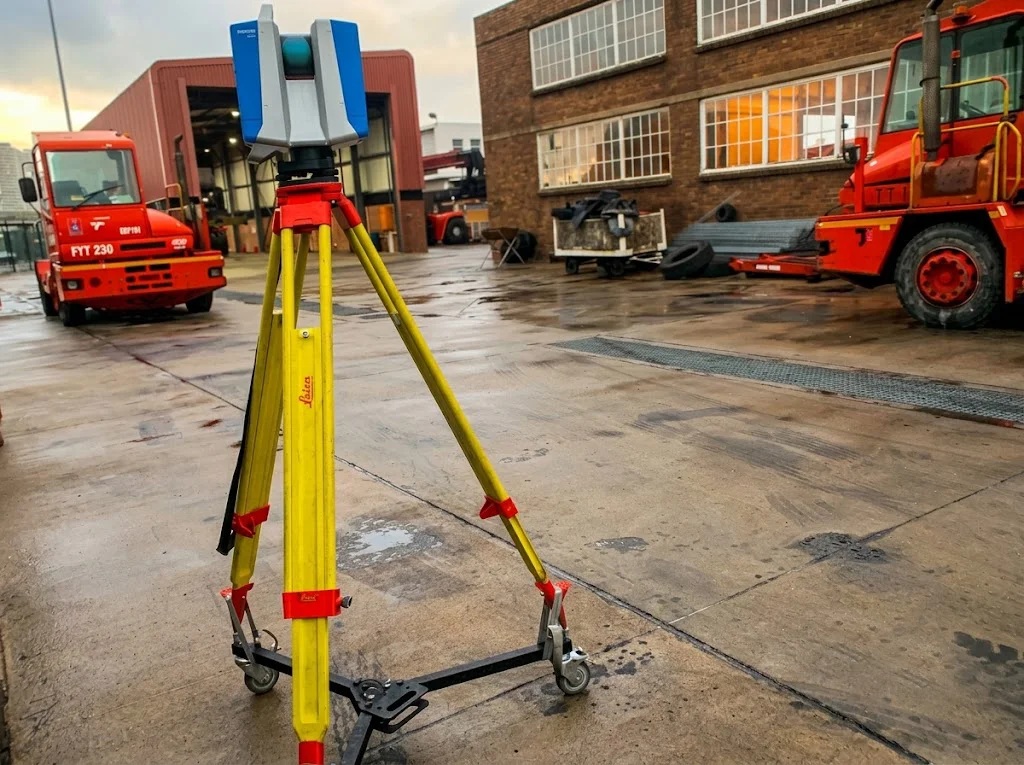
Micro Summary: See how 3D scanning for Plant Shutdown planning stops fit-up surprises and over budget Shutdown before it costs you, by Sandile Shembe.
3D scanning for plant shutdown planning exists because of a pattern I’ve seen too many times. Fabricated steel that didn’t fit, a pipe run that clashed with conduit nobody knew was there, a crew standing around while someone remakes something by hand. Every time, the root cause isn’t bad planning. It’s that the plant on the drawings and the plant on the ground stopped being the same plant years ago.
I’m Sandile Shembe, founder of Innosa Projects. We’re an ECSA-registered engineering firm based in Rustenburg, and we scan processing plants, conveyor systems, and shaft infrastructure across the Platinum Belt for a living.
Increasingly, that means being brought in specifically for 3D laser scanning for plant shutdown planning, before the schedule is locked, not after something doesn’t fit.
What is 3D Scanning for Plant Shutdown Planning?
3D scanning for plant shutdown captures the exact current geometry of your plant, every pipe, structure, conveyor, and piece of steel as a millimetre-accurate point cloud, so your engineering and fabrication teams design against what’s actually standing on site, not against drawings that are years or decades out of date.
It closes the gap between “as-designed” and “as-built” before your shutdown window opens, not during it.
That gap is the single biggest source of shutdown overrun, and it’s almost never captured in the original planning documents because nobody flags it until steel doesn’t fit.
Why do As-Built Drawings go wrong on older plants?
Plants change constantly, and documentation almost never keeps pace. Over a plant’s life:
- Emergency repairs get made without updating drawings
- Conveyors get relocated or extended during previous shutdowns
- Structural steel gets reinforced, braced, or modified on the fly
- Piping gets rerouted around obstacles that were never on the original P&IDs
- Foundations settle or shift, and nobody remeasures them
None of this is anyone’s fault. It’s what happens to a working plant over ten, twenty, thirty years. But it means the drawing your design team is working from is a historical document. Every design decision made against it is a guess.

What happens if you skip the scan and design against old drawings?
You find out during the shutdown which is the most expensive possible moment to find out. The pattern I see most often? New equipment or piping is fabricated off-site based on old drawings, it arrives on-site during the shutdown window, and it doesn’t fit, a flange is out of alignment, a support clashes with a cable tray nobody documented, a walkway obstructs the lifting path. Now you’re cutting, grinding, and modifying fabricated components on-site, in a window where every hour has a direct cost attached to it.
The most uncomfortable number worth sitting with? A properly scoped scan typically costs a small fraction of a single hour of unplanned shutdown downtime on a mid-sized processing plant. It’s not really an engineering line item. It’s insurance against the schedule.
If your next shutdown is already on the calendar, this is the point to act, not after the drawings come back wrong. Talk to an engineer directly. We’ll confirm scope, timeline, and cost within 24 hours.
How does 3D Laser Scanning for Plant Shutdown planning actually work?
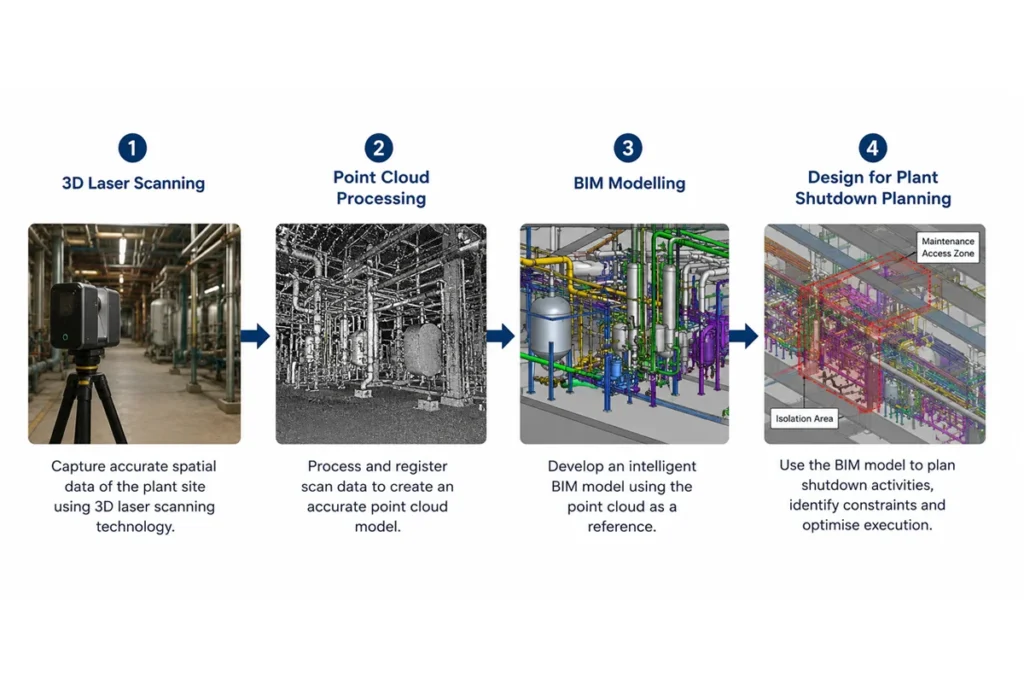
At Innosa, the process runs in four stages:
- Scan. FARO or Leica LIDAR captures the plant as a point cloud, typically without any operational shutdown required. We routinely scan active processing plants and operating mines with minimal disruption to production.
- Register and process. Millions of data points are cleaned, registered into a single coordinate system, and quality-checked for accuracy (±2mm).
- Model. Point cloud data is converted into as-built drawings or a full Scan-to-BIM model, imported directly into Revit, AutoCAD, Navisworks, or AVEVA, whatever your design team already works in.
- Design against reality. Your engineers, or ours, design upgrades, retrofits, or replacements against the real geometry, running clash detection before a single piece of steel is fabricated, not after it’s delivered to site.
As-built drawings are typically delivered 24–48 hours from site completion, which means this can be scheduled well ahead of your shutdown window without adding time to your critical path.
Does scanning an active mine or plant cause any downtime?
No. 3D laser scanning is completely non-intrusive. The scanner captures data optically, with no contact with equipment or structures. We regularly scan active processing plants, operating mines, and live construction sites across the Platinum Belt without interrupting production. This is one of the most common questions I get from plant managers, and it’s usually the point where the conversation shifts from “should we do this” to “when can you get on site.”
Is this relevant beyond mining? What about general industrial and infrastructure shutdowns?
Yes. The same principle applies to any brownfield environment. Like factories, warehouses, municipal infrastructure, and ports. We’ve delivered scan-based as-built documentation for an 8,000m² industrial facility in KwaZulu-Natal and conducted volumetric surveys across multiple sites for clients like Sappi and Mondi. The common thread is any plant or facility where the drawings and the reality have drifted apart, and where getting it wrong during a shutdown or retrofit is expensive.
What about mine health and safety compliance?
For mining clients specifically, accurate as-built documentation supports the documentation trail expected under the Mine Health and Safety Act, particularly for shaft infrastructure, conveyor systems, and processing plant structures where maintenance history and current condition need to be demonstrable, not assumed. Scan data gives you a defensible, dated record of exactly what condition the infrastructure was in at the time of capture. This is useful well beyond the shutdown itself.
All scan and design work is carried out to relevant SANS standards, and where structural findings come out of the scan data, they’re reviewed by our own ECSA-registered Professional Engineer, not handed off to a third party to sign.
A real example. Why did we start doing this?
Our first major mining sector engagement was 3D laser scanning, as-built documentation, and structural assessment for Hakhano Coal Mine, part of a R1.4 billion capital investment programme. That project is the reason our Platinum Belt client base exists at all. It’s what convinced us that scan-first, not drawing-first, was the only responsible way to plan work on an operating plant.
We’ve since run volumetric surveys across multiple coal stockpiles for Sappi’s KwaZulu-Natal facility. 15 stockpiles measured in two days, with volume accuracy within 2% for financial audit and production reconciliation, and applied the same scan-first approach to structural retrofit design for Mondi. The thread through all of it is the same. Measure the real thing first, design second.
It depends on facility size and complexity, but scanning itself is fast. Millions of data points are captured in minutes per scan position. As-built drawings are typically delivered 24–48 hours from site completion. Request a quote and we’ll confirm the timeline against your shutdown date.
No. Scanning is non-intrusive and is routinely carried out on active, operating plants and mines without interrupting production. It’s typically scheduled well ahead of the shutdown window itself, so it doesn’t add to your critical path.
A point cloud is the raw scan data. Millions of measured XYZ coordinates representing the exact geometry of the plant. A BIM model (Scan-to-BIM) converts that raw data into a fully coordinated, intelligent 3D information model that engineers, not just surveyors, can design directly from.
Yes. Point cloud data imports directly into Revit, AutoCAD, Navisworks, AVEVA, and most major engineering platforms, so your existing design workflow doesn’t need to change.
Yes. Platinum, chrome, and vanadium mining are core to our client base. We scan processing plants, conveyor gantries, headgear, and shaft steelwork across the North West Platinum Belt, working within the access, permit, and safety protocols specific to active mining environments.
Scanning cost depends on facility size and scope, but as a rule of thumb, a full facility scan is typically a small fraction of the cost of even a single hour of unplanned shutdown delay on a mid-sized plant. Talk to an engineer for a scope-specific quote.
Related Questions
- Can You 3D Scan an Active Mine or Plant Without Stopping Production?
- How Accurate Does 3D Laser Scanning Need to Be for Pipe and Steel Fabrication?
Book 3D Laser Scanning for Plant Shutdown Planning before your next shutdown, not during it.
If your next shutdown or turnaround is on the calendar and your drawings are more than a few years old, that’s the gap that costs you time. Talk to an engineer directly. No call centre, no middlemen. We’ll contact you within 24 hours. To confirm scope, timeline, and cost. Read more about our 3D laser scanning and Scan-to-BIM process, see how scanning feeds into structural inspections and engineering design, or browse our project portfolio for examples across mining, industrial, and infrastructure work.
Call +27 81 445 3066 or email info@innosaprojects.co.za. We’re based in Rustenburg, mobilise across the Platinum Belt, Gauteng, and KwaZulu-Natal, and work nationally.
Choice of related article 1
Choice of related article 2
