
What NDT actually does
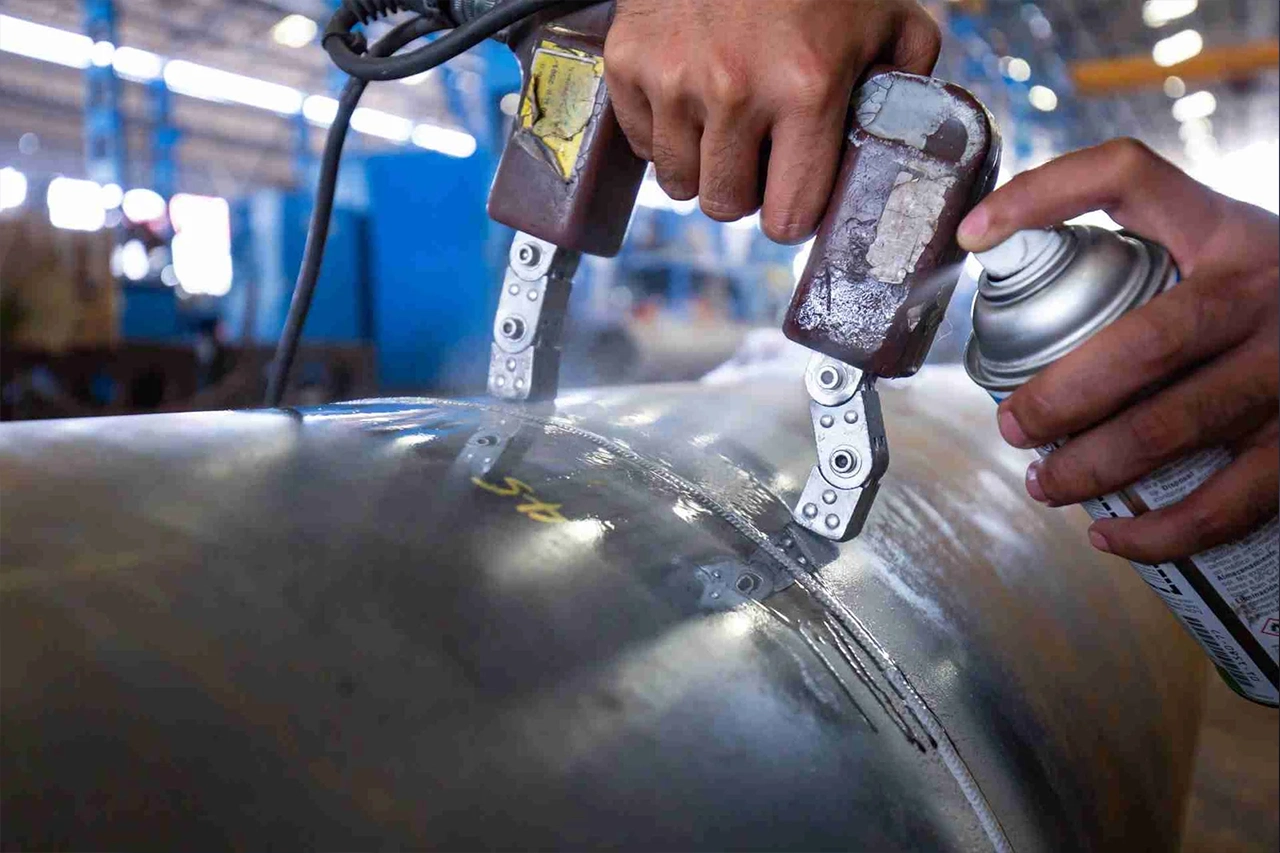
Non-destructive testing checks the internal condition of metal components without cutting, drilling, or dismantling anything. We send sound waves, magnetic fields, or radiation through the material and read what comes back. Cracks, voids, wall thinning, and weld defects. They all show up before they become failures.
For mining operations in Rustenburg’s Platinum Belt, processing plants in Gauteng, and pipeline operators across South Africa, that means you get accurate condition data on your critical assets without a single hour of unnecessary downtime.
Our NDT results feed directly into Structural Inspections and Engineering Design decisions so the data doesn’t sit in a report, it drives action.
What you get from every inspection:
- Written inspection report signed by a Level II certified technician
- Equipment calibration records with traceable certificates
- Defect findings mapped to location with photographic evidence
- Severity classification against the applicable acceptance code
- Clear accept/reject determination
- Repair or maintenance recommendations where defects are found
Operational Advantages
Non Destructive Testing Methods We Use
Ultrasonic Testing (UT & PAUT)
We transmit high-frequency sound waves through the material and measure what bounces back. This tells us wall thickness, internal crack depth, and weld quality, all from the outside surface. We use both conventional UT and Phased Array (PAUT) for complex geometries where a single beam isn’t enough.
Standard: ASME Section V, API 1104 | Cert: ASNT Level II
Radiographic Testing (RT)
Industrial X-ray and gamma-ray imaging creates a permanent visual record of what’s inside a weld. The image shows porosity, lack of fusion, and inclusions that nothing else will catch. Required for many pressure vessel and pipeline certifications.
Standard: API 1104, ASME Section V
Magnetic Particle Testing (MT)
We magnetise the component and apply ferrous particles. Any surface or near-surface crack disrupts the magnetic field and shows up immediately. Particularly effective on structural steel weld toes where fatigue cracks start.
Dye Penetrant Testing (PT)
Penetrant fluid seeps into surface-breaking cracks. Developer pulls it back out and makes it visible. Works on any material – steel, stainless, aluminium, titanium. Catches defects that polished surfaces hide.
Eddy Current Testing (ECT)
Electromagnetic induction detects flaws in conductive materials without contact. The method of choice for heat exchanger tube inspection – hundreds of tubes screened quickly, with no tube removal required.
Industrial Applications
- Oil & Gas Pipelines
- Power Generation
- Manufacturing & Fabrication
- Aerospace & Transport
- Pipeline weld integrity inspections
- Pressure vessel and storage tank certification
- Corrosion mapping under insulation (CUI)
- Casting and forging defect analysis
Technical Capabilities
Certified Professionals
Our technicians hold ASNT Level II and Level III certifications, ensuring that every inspection is conducted with the highest level of competence and interpretive skill.
Comprehensive Compliance
We operate in full compliance with ISO 9712 and relevant SANS codes, providing you with inspection reports that stand up to the most stringent regulatory audits.
Advanced Diagnostics
Utilising the latest ultrasonic and radiographic equipment, we detect even the smallest sub-surface defects to guarantee the structural integrity of your critical assets.
We bridge the gap between inspection and action. Our NDT findings are seamlessly integrated into our Structural Inspection workflows and used to validate complex Engineering Design requirements.
Our Certifications
Every Innosa NDT technician is certified to ASNT SNT-TC-1A and ISO 9712 Level II. That’s not a box we tick – it’s the standard that mines, insurers, and engineering firms ask for when they need to know the results mean something.
We use Olympus EPOCH 650 ultrasonic instruments and GE Eddy Technologies equipment. The same kit used by major South African industrial operators. Calibration records are traceable and included in every report.
Regulatory Compliance & Accuracy
| Methods | UT, PAUT, RT, MT, PT, ECT, TOFD |
| Certification | ASNT SNT-TC-1A / ISO 9712 Level I & II |
| Equipment | Olympus EPOCH 650, GE Eddy Technologies, Iridium 192 |
| Standards | ASME Section V, API 1104, AWS D1.1, SANS, MHSA |
| Reports | Digital, ISO 9712 compliant, audit-ready |
| Base | Rustenburg – rapid mobilisation North West & Gauteng |
Ideally, get in touch 2–4 weeks before your maintenance window kicks off. That gives us a comfortable runway to lock down the right inspection methods, plan site access, clear the regulatory paperwork, and get our teams mobilised. That said, if you’re facing an emergency or an urgent inspection, we can have a team on-site within 24 hours – both across the North West Platinum Belt and nationwide.
Yes. Mining is our primary sector. We inspect welded structures, pressure vessels, and process plant equipment for mining clients across the North West Platinum Belt, fully compliant with MHSA requirements. We understand the permit process, the safety rules, and the documentation your safety department needs.
In most cases, yes. Ultrasonic testing, eddy current, and magnetic particle inspection are all performed on in-service equipment. We’ll tell you upfront if anything requires shutdown access, no surprises on the day!
For clients in North West Province and Gauteng, we can typically have people on site within 24–48 hours. Call +27 81 445 3066 directly, we’ll give you an honest answer on availability.
Yes. Every report includes the procedure reference, technician certification details, calibration records, and clear accept/reject determinations per the applicable code. We structure reports to satisfy engineering firms, insurance assessors, and mine safety departments.
A Level I technician performs tests under supervision. A Level II independently plans the inspection, operates the equipment, interprets results, and signs the report. Every Innosa inspection report is signed by a Level II certified technician, that’s the standard that matters for formal acceptance.